Your CRM says the quarter is healthy. Your forecast call says something different. The pipeline is full of “good conversations,” a few late-stage miracles, and a long tail of deals that keep slipping a week at a time until nobody can remember why they were ever committed in the first place.
That's the problem with sales opportunity management. It isn't just tracking deals, it's deciding which opportunities deserve attention, which ones should be downgraded, and which ones are polluting the forecast. Modern buyers research early and often, with 96% of prospects researching companies and products before speaking to a sales rep, 71% preferring independent research over a rep conversation, and an average win rate of 21% reported in industry guidance from Zendesk and HubSpot's referenced figures in the same guide (Zendesk opportunity management guide). That means the old habit of counting every interest signal as pipeline doesn't hold up anymore.
Why Your Pipeline Is Lying to You
A sales leader opens the dashboard on Monday and sees a wall of green. Rep notes are active, the stage mix looks full, and the forecast call has not been challenged yet. Then the month closes, and half the “committed” revenue never had a real buyer behind it.
That gap is why sales opportunity management matters. It is the operating discipline of tracking, qualifying, and moving deals through structured stages with real exit criteria, not just logging every conversation as if it were revenue. In practice, it keeps managers from treating weak signals as real pipeline and forces the team to separate genuine buyer motion from optimism.
The problem usually starts with the “maybe” deals. They sit in late stages because nobody wants to downgrade them, the rep still has a call on the calendar, or the customer said they were “circling back” and no one wanted to challenge it. Those deals are forecast poison. They absorb attention, make coverage look healthier than it is, and teach the team that stage names matter more than buyer evidence.
What changed in the buyer journey
The buyer enters the conversation with context, preferences, and a shortlist already forming. By the time a rep gets involved, the work is less about discovery from zero and more about validating urgency, confirming fit, and earning the right to move the deal ahead. Opportunity management is a qualification system for moments of buyer intent, and it has to be strict enough to keep ambiguous deals from blending into real ones.
If your team wants a practical baseline for better deal hygiene, this pipeline management for contractors resource is a useful complement to the broader process view.
The discipline also starts with data quality. If fields are missing, timestamps are inconsistent, and stage changes depend on rep optimism, the forecast turns into a story the CRM tells itself. For a closer look at cleaner records and better CRM hygiene, see this guide on CRM data quality.
Practical rule: if a stage can be advanced without a buyer action, the stage is probably too soft.
That is the line many sales teams cross without noticing. They call it pipeline management, but they are really managing hope.
The Opportunity Lifecycle and CRM Stages
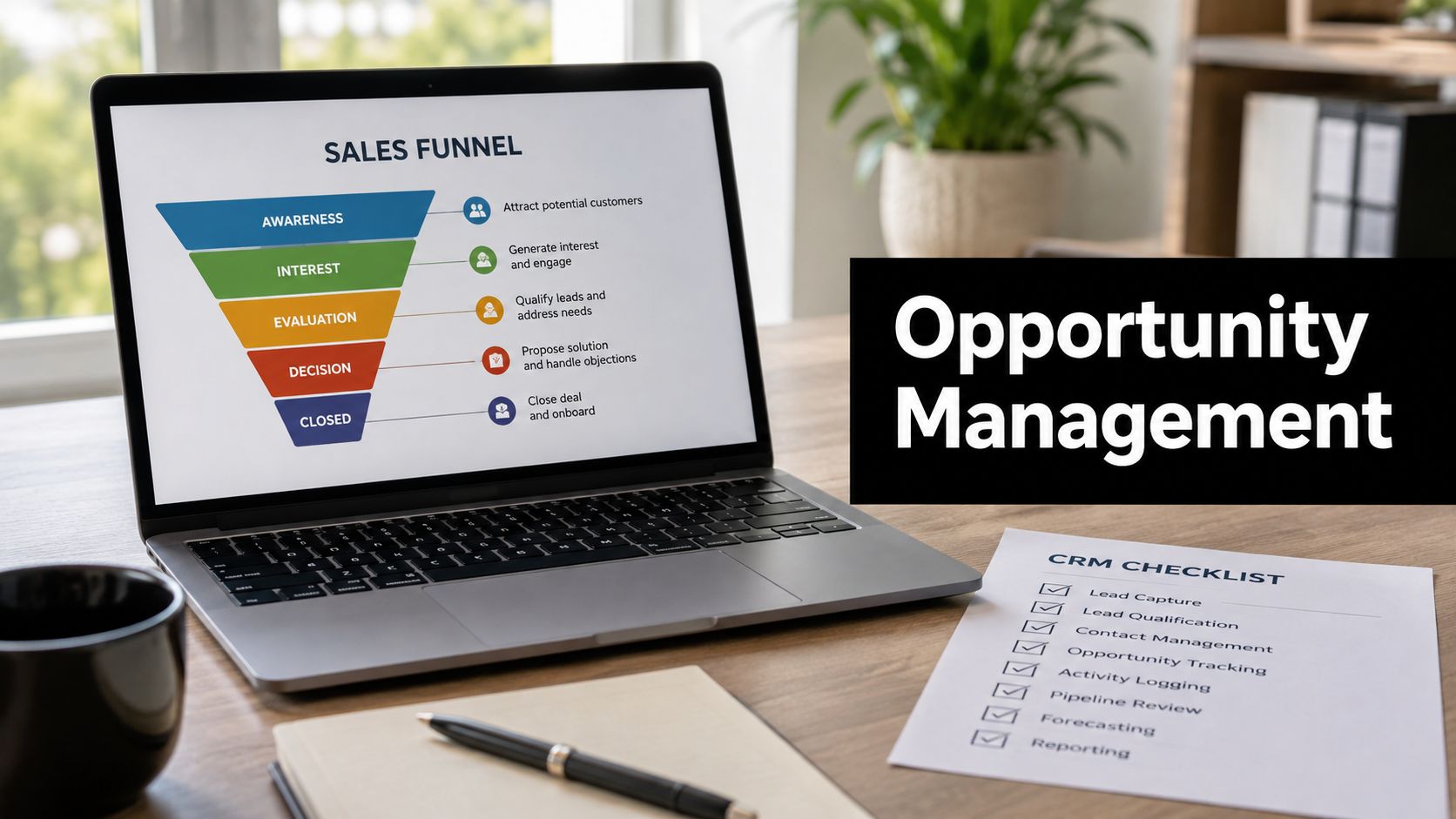
A useful lifecycle is simple enough for reps to follow and strict enough for managers to trust. The point is to track a deal through a few clear gates, such as lead capture, discovery, proposal, and closure. The mistake is turning those stages into labels instead of gates.

Build stages around buyer evidence
A stage should only exist if the buyer has done something specific. At capture, the deal should have a source, a rep assignment, and a clear next action. In discovery, the record should hold qualification notes, stakeholder details, and a timestamp that proves the rep didn't just inherit an old lead and relabel it.
By the time a deal reaches proposal and negotiation, the CRM needs to reflect more than enthusiasm. It should show decision process, next steps, stakeholder involvement, and a probability score that changes only when buyer behavior justifies it. Weak CRM hygiene does the most harm here, because speculative deals can look legitimate until the quarter ends.
Map the lifecycle to inbound and outbound motion
Inbound opportunities usually enter with more signal at the top, because the buyer already initiated contact. Outbound opportunities need tighter entry criteria, since interest is weaker and the rep has to earn progression faster. The stage definitions can be shared across both motions, but the evidence required to move forward should not be identical.
For operational guidance on opportunity objects and workflow design, the Surva.ai opportunities docs are a helpful reference point for how structured records and lifecycle logic can work in practice.
When I've seen stage governance work well, it has always had the same shape. A rep can't advance a deal unless one buyer event has happened, the next step is dated, and the record includes who else is involved. If those conditions aren't met, the opportunity stays put or gets recycled. No exceptions.
The same logic applies to lead-to-opportunity handoff. If your definitions between MQL and SQL are fuzzy, the pipeline inherits that fuzziness downstream. A useful reset on that boundary is this explainer on MQL and SQL definitions.
The KPIs That Actually Predict Revenue
A big pipeline can still be a weak one. What matters more is whether deals are moving, slipping, or stalling in ways that match buyer behavior. I watch stage velocity, stage-loss rate, stage-progression probability, and pushes, because those four metrics expose how opportunities behave, not how tidy they look in CRM. If those numbers are soft, the forecast usually is too (RevOps Coop on opportunity best practices).
The math behind throughput
The cleanest way to measure throughput is pipeline velocity. The standard formula is Number of Opportunities × Average Deal Size × Win Rate ÷ Sales Cycle Length (Optif.ai sales metrics dashboard guide). Revenue rises when qualified opportunities increase, deal size rises, or win rate improves, and it slows when the cycle drags.
| KPI | Formula | What It Reveals |
|---|---|---|
| Stage velocity | Stage entry date to stage exit date | Where opportunities move quickly or stall |
| Stage-loss rate | Lost opportunities ÷ total opportunities in a stage | Where the funnel is leaking |
| Stage-progression probability | Wins from a stage ÷ opportunities entering that stage | How believable each stage really is |
| Pushes | Count of close-date changes | How often forecast dates slip |
A clearer view of throughput also helps teams connect pipeline health to reporting discipline. If you want that angle, this sales pipeline value guide is a useful companion.
Early signals beat late-stage optimism
A study summary on sales opportunity management found that winning opportunities received 2x more inbound emails in the first few weeks than losing opportunities, and by the fifth week they had engaged 1.5x more contacts. It also found that winning opportunities were handled with less than 6 hours a week spent on them, and the authors concluded that those metrics could save 30% of time while improving focus and forecasting (study summary).
That pattern comes up in real pipeline work all the time. More rep time does not rescue a bad deal. Better time allocation does. Early email volume and stakeholder breadth are stronger signals than close-date optimism, because they show whether a buying process is forming.
The best forecast is built from repeated stage behavior, not gut feel.
Discovery-to-pipeline conversion is often benchmarked at 10% to 30% on average, and outbound teams are frequently expected to drive 50 to 100 dials per day, a 3% to 10% connect rate, and about 3 to 5 quality conversations per day (Factor 8 sales metrics by role). Those numbers are not useful as vanity targets. They matter because they tie activity, connect rates, and pipeline creation together, which is where most pipeline math gets exposed.
Best Tools for Capturing and Qualifying Opportunities
The best tool stack starts before a rep touches the record. If capture is slow, qualification is manual, and routing happens by email, the pipeline becomes a cleanup job instead of a revenue system. That's why I look first at tools that reduce friction at the point of entry and preserve signal all the way into CRM.
Orbit AI belongs in that conversation because it combines form capture with AI-driven qualification, enrichment, and routing in one flow. Typeform still does polished forms well, but it leaves the qualification burden on downstream systems and people. Traditional CRM intake forms usually capture data, yet they rarely separate curiosity from real buying intent in real time.
How the trade-offs actually show up
Orbit AI is useful when teams want submissions scored as they come in, then routed to the right rep or workflow without manual triage. That's especially important when SDR teams are dealing with mixed intent, because the gap between “submitted a form” and “ready for sales” is where many pipelines get noisy. The practical difference is not just prettier forms, it's whether a submission enters the pipeline as a conversation or a ticket.
For teams comparing capture and routing logic more broadly, Surnex's audience and channel analysis is a solid lens for deciding where opportunities originate and how they should be segmented.
A useful shortlist for tool evaluation
- Orbit AI. AI-native forms, scoring, enrichment, routing, and real-time analytics in one capture layer.
- Typeform. Strong UX for forms, useful when capture quality matters but qualification can happen later.
- CRM native forms. Convenient for simple routing, but often limited when you need richer qualification logic.
- Sales engagement tools. Better for follow-up and sequencing after capture, not for first-touch qualification.
The wrong question is which tool creates the most submissions. The right question is which one gives you the cleanest handoff into the pipeline with the least manual cleanup. If forms, enrichment, and routing sit in separate systems, weak opportunities slip through because nobody is responsible for resolving ambiguity at intake.
For a deeper view of how form capture can connect to automated sales workflows, this guide to AI agents for sales is worth a look.
Common Mistakes That Destroy Pipeline Accuracy
The most damaging mistake is keeping weak opportunities alive because nobody wants to have the hard conversation. A speculative deal sitting in a late stage can distort the forecast more than a missing deal ever could. That's why the question isn't whether to score opportunities, it's how to govern the “maybe” ones without contaminating committed revenue.

What usually breaks first
Weak opportunities linger when there's no downgrade rule. If a deal misses its next step, loses engagement, or can't produce a clear buyer action, it should move out of commit or into a recycle status. Leaving it in play because “the champion still likes us” is how inflated forecasts survive another week.
The second failure is stage drift. A deal in proposal that still needs basic qualification doesn't belong there, even if the rep is confident. Generic scoring factors like fit and engagement help only when the CRM has explicit rules for what score changes mean operationally.
A disciplined response to maybe deals
- Keep it active when the buyer has real engagement, the next step is scheduled, and the stage evidence is current.
- Downgrade it when the close date slips without a buyer-driven reason, or the opportunity loses its stakeholder coverage.
- Recycle it when the timeline is real but distant, the pain isn't urgent, or the buyer has gone quiet after repeated follow-up.
Practical rule: if no one can explain why a deal is still in the current stage, it's already a bad forecast record.
The fourth failure is ignoring loss reasons. Closed-lost data often gets skipped because reps want to move on. That hurts coaching, weakens source analysis, and leaves the team blind to recurring objections. The discipline isn't glamorous, but it's where accurate forecasting starts.
How to Operationalize Your Opportunity Workflow
Opportunity management works only when the process shows up in daily behavior. The CRM needs mandatory fields, the automations need clear triggers, and the weekly review needs to focus on stage movement instead of storytelling. The goal is to make it easier to tell the truth about a deal than to avoid it.

Build the record first
Every opportunity should carry source, stage timestamp, assigned rep, value, and stakeholder data. If a field does not help explain why a deal moved, stalled, or won, it probably should not be required. The point is to support stage-to-stage analysis, not create admin work that reps ignore.
That starts with cleaner intake. When Orbit AI captures a submission and syncs it instantly into the CRM, the team gets better handoff data without waiting for manual entry. For the mechanics behind those handoffs, the workflow guide on building a workflow is a useful reference.
Use automation to protect momentum
Automation should do three things. It should remind reps when a deal has gone stale, trigger a task when a stage criterion is met, and alert managers when a high-value opportunity slips. Anything beyond that is decoration until the basics are working.
The value is in making the next step harder to skip than the update itself. If a rep cannot advance a deal without adding the buyer action, stakeholder change, or evidence that justifies the move, the CRM stays honest. That is especially important for the maybe deals that drift around the forecast and look active only because nobody has forced a decision.
Keep the review cadence tight
A weekly pipeline review should ask three questions. What moved, what stalled, and what changed in buyer behavior. If the answer is mostly rep opinion, the meeting is not doing its job.
A practical agenda looks like this:
- Review stage changes since last week.
- Check opportunities with pushed close dates.
- Inspect stale deals by stage.
- Confirm next actions and owners.
- Separate commit, upside, and recycle buckets.
The point is not to run a status meeting. It is to expose where stage evidence has gone thin, where scoring no longer matches reality, and where a rep is carrying a deal because it feels possible. For teams formalizing stage rules and automation, a clear pipeline dashboard and a well-defined workflow built from on building a workflow do more for discipline than another round of forecasting philosophy ever will.
Putting It All Together With a Real Pipeline Example
A B2B SaaS team with a bloated pipeline usually doesn't need more leads first. It needs fewer false positives, cleaner stage definitions, and tighter qualification at intake. Once the team stops treating every interested account like equal revenue, the forecast starts to behave.

In practice, the strongest teams do four things. They prune low-probability deals, require mandatory CRM fields, run weekly reviews, and train reps on exit criteria. They also tighten capture at the top so the pipeline starts with better data, not just more volume.
The audit checklist is straightforward. Verify CRM hygiene, check whether stage governance has real buyer evidence, inspect KPIs for slip and stall patterns, and confirm that tools sync cleanly from capture to CRM. If any of those links break, the forecast will keep lying even if the dashboard looks polished.
Sales opportunity management becomes much easier when the intake layer, scoring logic, and stage rules all work together. Orbit AI is built to capture and qualify leads with AI-powered forms, instant enrichment, and routing that sends stronger opportunities into the right sales motion. If your team wants cleaner pipeline entry and less manual triage, visit Orbit AI and see how it can help turn every form into a qualified conversation.